
The shift to integrated rangefinders
Hunters used to carry a separate rangefinder and binoculars, which meant fumbling with two devices while a buck was moving. Putting the laser inside the glass changed that. It’s faster and keeps your eyes on the target instead of looking down at your chest rig.
Early adopters of combined rangefinder-binocular systems were primarily in tactical and military applications, where speed and precision were paramount. This demand drove early innovation and miniaturization of the necessary components. Now, those advancements are filtering down to the hunting market, creating a demand for optics that perform multiple functions without sacrificing optical quality.
The benefits are clear: reduced weight from carrying one less device, quicker target acquisition, and a more intuitive workflow. A hunter can glass an area and instantly determine the range to a potential target, without the awkwardness of switching between devices. The cost of entry was initially high, but competition and technological progress are steadily making integrated rangefinder binoculars more accessible.
Ballistics and smart sensors
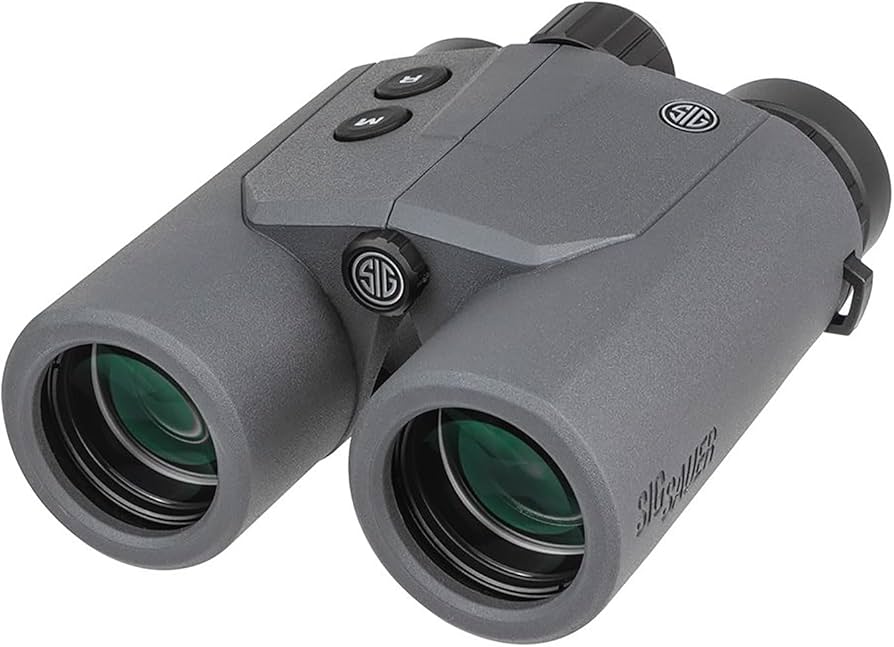
The evolution didn’t stop at simply combining two devices. Modern high-end hunting binoculars are now incorporating 'smart' features that go far beyond basic rangefinding. Applied ballistics calculations are becoming increasingly common, compensating for bullet drop and wind drift to provide more accurate shot placement.
These calculations aren't just simple estimations. Sophisticated models account for angle to the target, which is critical in mountainous terrain, and can be customized with specific ammunition data. Environmental sensors – measuring temperature, humidity, and barometric pressure – further refine these calculations, providing a more precise solution. Data logging capabilities allow hunters to record shot data for analysis and future reference.
These optics are basically computers with lenses. You can update the firmware via Bluetooth to get better ballistic profiles or bug fixes. It makes the gear feel less like a static tool and more like something that grows with your setup.
Top models for 2026
The hunting binocular market is competitive, with several manufacturers pushing the boundaries of integrated technology. Here's a look at some key models, representing the state-of-the-art as of late 2026. Note that pricing and availability will vary.
Swarovski AX Visio: Swarovski continues to lead in optical quality, and the AX Visio integrates rangefinding with their exceptional glass. It boasts a measurement range of up to 1,300 yards, and offers a ballistic assistant. The display is clear and customizable, and the binocular is surprisingly lightweight for its feature set. Expect a price in the $3,500 - $4,500 range.
Leica Amplus 6: Leica’s Amplus 6 combines superb optics with a precise rangefinder. This model focuses on ease of use, with intuitive controls and a bright, easy-to-read display. It provides angle compensation and can store multiple ballistic profiles. The Amplus 6 typically sells for around $3,200 - $4,000.
Zeiss Victory RF: Zeiss is well-regarded for durability and optical performance. The Victory RF offers a range of up to 1,200 yards and incorporates a ballistic calculator that can be customized via smartphone app. The binocular is known for its robust construction and weather resistance, with a price tag around $3,000 - $3,800.
Vortex Impact BX-1 LR: Vortex offers a more affordable entry point into the integrated rangefinder market. The Impact BX-1 LR provides reliable rangefinding up to 1,000 yards and features a simple, user-friendly interface. While it lacks the advanced ballistics calculations of higher-end models, it's a solid option for hunters on a budget, typically around $1,000 - $1,500.
Sig Sauer BDX: Sig Sauer has made significant strides in smart optics. The BDX binoculars integrate seamlessly with their BDX ballistic app, allowing for precise holdover adjustments. They offer a range of up to 1,200 yards and feature a clear, OLED display. Pricing is competitive, generally between $1,500 - $2,500.
Hunting Binocular Roundup: 2026 – Smart Feature Comparison
| Model | Magnification | Weight (oz) | Rangefinder Integration | Ballistics Calculation | Environmental Sensors | Estimated Price Range (USD) |
|---|---|---|---|---|---|---|
| Swarovski AX Visio | 8x42 | 30.3 | Integrated | Advanced, customizable profiles | Yes, temperature, barometric pressure, humidity | $2,800 - $3,500 |
| Zeiss Victory RF | 10x42 | 32 | Integrated | Basic, holdover reticle | No | $2,500 - $3,200 |
| Leica Noctivid | 8x42 | 28.6 | Optional external module | None | No | $2,200 - $2,900 |
| Vortex Razor UHD | 10x42 | 30.5 | Optional external module | Basic, manual adjustments | No | $1,800 - $2,500 |
| Maven B.1 | 10x42 | 31.5 | Optional external module | None | No | $1,500 - $2,200 |
| Sig Sauer Tango XD | 10x42 | 33 | Integrated | Basic, with angle compensation | No | $1,600 - $2,300 |
Illustrative comparison based on the article research brief. Verify current pricing, limits, and product details in the official docs before relying on it.
How the ballistics math works
The ballistics calculator within a hunting binocular isn't magic; it's a sophisticated application of physics. It requires accurate input data, most importantly: bullet weight, ballistic coefficient (BC), and muzzle velocity. The BC is a measure of how aerodynamic the bullet is, while muzzle velocity is the speed at which it leaves the barrel.
The binocular then uses this data, along with the range to the target and the angle to that target, to calculate the amount of bullet drop and wind drift. It then presents this information to the hunter in the form of holdover adjustments – how much above or to the side of the target to aim. Some binoculars display this as a series of dots or lines on the reticle, while others provide numerical values.
The math is only as good as your data. If your muzzle velocity is off by 50 fps or you didn't account for a 10-degree temp drop, the solution won't be right. Wind is still the biggest variable that these sensors can't perfectly solve for you.
Glass displays and usability
Presenting rangefinding and ballistics data requires a clear, readable display. Several technologies are used, each with its own strengths and weaknesses. OLED (Organic Light-Emitting Diode) displays offer excellent contrast and brightness, even in low-light conditions, and consume relatively little power. LCD (Liquid Crystal Display) screens are more affordable but generally have lower contrast and may be harder to see in bright sunlight.
Projected displays, where the data is projected onto the optical path, offer a less obtrusive viewing experience, but can be susceptible to distortion or washout in certain conditions. Brightness, clarity, and resolution are all critical factors. A dim or blurry display is useless in the field.
Usability is equally important. The display should be customizable, allowing the hunter to choose which data points are displayed and how they are presented. Controls should be intuitive and easy to operate with gloved hands. The ability to adjust the display brightness and contrast is also essential to adapt to different lighting conditions.
- Brightness settings that let you dim the display for dawn or crank it up for midday sun.
- Data fields you can toggle so the screen isn't cluttered with info you don't need.
- Buttons that are spaced far enough apart to use while wearing heavy gloves.
Power and battery life
Smart hunting binoculars, with their rangefinders and ballistics calculators, demand significant power. Most models utilize standard AA or CR2032 batteries, while some are now incorporating rechargeable lithium-ion batteries. Battery life varies considerably depending on usage patterns – frequent rangefinding and ballistics calculations will drain the battery faster.
Expect a typical battery life of 8-12 hours with moderate use for AA/CR2032 powered models, and potentially longer with rechargeable options. Many binoculars include power-saving modes, such as automatic shut-off, to conserve battery life when not in use. Cold weather can significantly reduce battery performance, so it’s wise to carry spare batteries or a portable power bank.
Emerging power solutions include solar charging, although this technology is still in its early stages. The integration of more efficient processors and displays will also play a role in reducing power consumption in future models.
No comments yet. Be the first to share your thoughts!